All this month Alabama Public Television (APT) will finally be airing their original documentary film Alabama Craft: Tradition and Innovation, which will feature one of our members, potter Charles Smith.
The first airing will be this Thursday, April 9th at 7 pm. For a more complete program schedule for this program, please check out their site. Well done, Charles!
Showing posts with label mobile. Show all posts
Showing posts with label mobile. Show all posts
Won't You Join Us on Dec 6th?

We are pleased to be presenting our Third Annual Christmas Art Show and Sale, where we will be showcasing our eclectic mix of fine art and fine craft at the Mobile Botanical Gardens located at 5151 Museum Drive, Saturday, December 6, from 9 am to 4 pm.
Not to be confused with Bellingrath Gardens, the MOBILE BOTANICAL GARDENS is nestled in the heart of The Village of Springhill across from Langhan Park and the Mobile Museum of Art. (see map & directions below or, if you prefer view the Google Map)
Our one day event is held in conjunction with The Master Gardeners' Annual Greenery and The Botanical Gardens' Annual Poinsettia Sales. The Master Gardeners, who are always ready to share their expertise, play an instrumental role in making the Gardens as beautiful as it is.
Their handmade fresh garlands, centerpieces, and other seasonal greenery, are most professionally executed and surprisingly reasonably priced. And did you know that there are over 50 varieties of poinsettias, and that just about every one can be found on sale at the Mobile Botanical Gardens that weekend?
Directions to the Botanical Gardens

: (courtesy of the Botanical Gardens)
1. On I-10, take I-65 North
2. Take Springhill Exit (5A), turn left
3. Go over Spring Hill. At the bottom of hill, Langan Park will be ahead.
4. Turn left at traffic light onto Pfc. John New Drive.
5. This dead-ends almost immediately onto Museum Drive. Turn right.
6. Pass the Mobile Museum of Art on the right, then look for the Gardens entrance on the left.
7. Turn left to enter the Gardens.
(NB: Map shown is not to scale)
For more information about our event and group, please contact:
Charles Smith (251) 432-3705 or
Anne Webb (251) 965-6661
We look forward to seeing you there for a day of art, greenery, and holiday cheer!


Kurtis N Thomas, Serigraphy (Fine Art Screenprinting) - Mobile AL

"When I was in college, earning a BFA degree in art, I asked one of the professors why he made art. Waiting in anticipation of his answer, I was expecting some deep philosophical reasons. I will never forget his answer. He said, “I make art because I like to make art.” Over the years I have come to realize that his answer was a deep and insightful reason to create art. I make art because I like to. I believe God made people in His image. God is creative and thus, we are creative."
Kurtis Thomas was born on 3/26/55 in Fresno, California, and has resided in Mobile since the age of ten. He lives with his wife Brenda, daughter Karen, and three cats. He received his BFA from the University of South Alabama in 1977 with a major in commercial art and minor in painting. He then spent several years as advertising art director for a chain of regional home centers. In 1981 Thomas began to exhibit his artwork as a professional artist. His artwork has been shown at reputable galleries and juried art shows across the country. He has work in private and corporate collections in the United States, Japan, England, Australia, and Canada. He has received many awards and prizes for his artwork.
In 2001, Thomas had the opportunity to join the curatorial staff at the newly renovated Mobile Museum of Art. After serving as an art exhibition technician, Thomas became the head registrar at the museum.
Thomas is proficient in drawing and painting in all types of mediums, but his public reputation is built on the fine quality serigraphs he has created by hand since 1981.
"Serigraphy... requires one to think in terms of mass and color instead of just thinking linear. "
Serigraphy, or silkscreen printing, is a stenciling technique which produces fine art, limited edition prints which are signed and numbered by the artist. From the initial idea to the drawing, making the stencils, to hand application of the ink to paper, Thomas performs each step of the process by hand. After completion of an edition, all stencils for that edition are destroyed. This ensures that each print is truly a unique, limited edition piece of art. In today's age of automated technology and photomechanical reproduction, this kind of fine art printing created entirely by the artist has truly become a rarity.
 Thomas has an imaginative style and unusual, delightful perspective that can place ordinary (or not-so-ordinary) subjects in a world just a few steps removed from reality. These walks into the "looking glass" are always composed with a serious eye for the best design possible, and may require from 20 to 80 stencils.
While most silkscreen artists use only a few stencils with large areas of flat color, Thomas strives for texture, form, value and a wide range of colors achieved only by the use of multiple stencils and stenciling techniques. This results in a true "painterly" effect, and over the years has given him the reputation of a master in his field.
Subject matter includes landscapes, water scenes, birds, houses, flowers, fish, cats, and the Christmas story. His whimsical cat prints get the most vocal response from viewers, as almost everyone recognizes his own feline companion in at least one. But his Christmas prints have also attracted a large following of collectors. In 1981, Thomas created his first Christmas silkscreen print, "O Night Divine," which depicted Mary and Joseph traveling through a snowy forest at night on the way to Bethlehem. He created from one to three new Christmas prints annually through the year 2000, always basing them on the Biblical story of Christ's birth.
Kurtis Thomas has a personal goal of always doing the very best work possible while looking for new ways to grow and new subjects to explore. He feels his work has improved by studying several artists he admires, such as Thomas Hart Benton, Albert Pinkham Ryder, Henri Rousseau and Paul Klee.
 He has often been recognized for his unique mastery of the silkscreen medium, but says, "While the recognition and awards are nice, I think the most important things to me are my own personal satisfaction in the work, achieving the standards I set for myself, and the enjoyment of the people who buy the work and look at it every day. They are telling me they want quality work and appreciate it, and that means a lot to me."
Charles Smith, Pottery - Mobile AL
 Charles Smith is a well-known and well-liked Mobile, AL, potter who began his career in the early 1970’s: “I began studying art after a tour of duty in Vietnam, the trauma surrounding the war made me want to pursue the arts.”
Smith matured his interest in the arts by earning a Bachelor of Science degree in Art Education with a minor in Pottery from Jackson State University in Jackson, MS. There he served as a Teacher Assistant to the late professor Marcus Douyon. Smith credits Douyon with providing a solid foundation of artisic discipline, skill and vision that would help him grow into the artist he is today.
In 1977, he was hired by the City of Mobile as a resident artist, during which time he painted murals and taught art in city parks and recreation centers. Since that time, Smith has won some 25 first place or Best of Show awards for his work. His work was included in the traveling exhibit: “Uncommon Beauty in Common Objects: The Legacy of African American Craft Art.” He has exhibited all over the country, including the National Museum of American Art in theSmithsonian Institution in Washington, DC, and the American Craft Museum in New York City. His most recent work uses bold colors such as black and tan.
 “I’ve been doing this for several years now, and in that time my work has evolved remendously, but it has not changed all that much. Art for me has been a maturing process, not a series of radical departures.”
Smith said he is always attentive to the technical aspects of clay and glazes, considering their limitation, and at the same time, employing the unimagined possibilities they hold. His forms are classic, and his glazes are sophisticated in color and application.
Charles uses cone 7 stoneware and decorated each piece using a carved-and-sgraffito technique. The style is derived from realistic and Art Nouveau forms, mixed with and interspersed with abstract animal imagery.
While the size and shape of each pieces is unique, it is – and always has been – the hand-carved surface that distinguished his work. Designs used today originated in design elements first explored in the late 1970’s. “They are the shapes and patterns of nature, and until Mother Nature finds it necessary to rediscover herself, I’ll remain content following her lead.”
Visit Charles Smith's web site: www.smith-pots.com

Jaclyn Benedict, Unique Handcrafted Fine Jewelry - Mobile AL
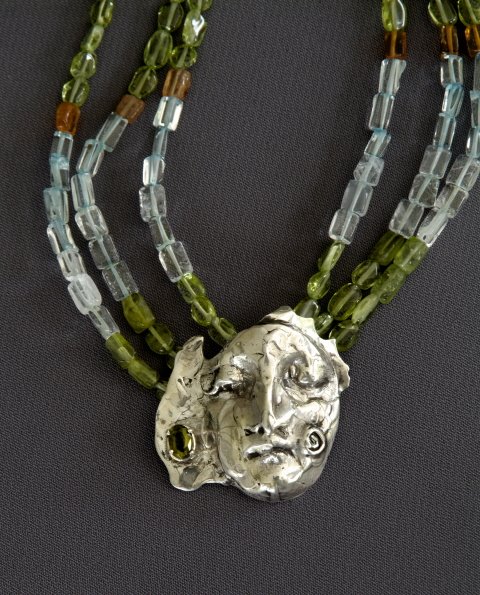 In 1974, when Jaclyn was in her sophomore year at the University of South Alabama, she happened to look through a doorway into a new art class being offered by Lloyd Patton. The class was metal smithing. She dropped her handful of clay and never looked back.
Jaclyn spent two years under Mr. Patton’s tutelage, studying jewelry design and the many varied techniques of working with precious metals. Over the years, she has increased her knowledge by talking to other artists and taking classes from such sources as master wire wrapper Preston Luther, Fairhope artist Betsy Sable and the William Holland School of Lapidary Arts. Jaclyn’s pieces of wearable art are created by but are not limited to hand building, wax carving and casting and wire wrapping all done in silver and/or gold.
 Colored stones also fascinate Jaclyn. She began experimenting with and using many different and unusual types of gem material in her pieces. “I like my jewelry to reflect the personality of the wearer. I prefer my stones to be freeform and the finished piece to certainly not be something you would find in a jewelry store.” Jaclyn has traveled across the United States visiting sites where she has been able to dig gem material and has been in numerous Gem & Mineral Shows. She travels to Tucson, Arizona each year for the Tucson Gem and Mineral Show.
Robert "Spike" Cloninger, Fine Lathe Turned Vessels - Fairhope AL

I am making wooden vessels - bowls, urns, vases, goblets - hand turned on a lathe, or hand carved, or both. My medium is wood that I harvest directly from tree or stump.
The wood that I work with is of no value to more conventional woodworkers. The twisted and gnarled crotches, burls and roots that I use are left in the forest
 by harvesters of lumber and pulp. Even firewood gatherers disdain the pieces that I routinely seek. The odd shaped, unwieldy, chunks that won’t split and won’t stack and won’t fit in the fireplace - these are the treasures to which I am attentive, and which come under my hand.
Most of the vessels that I make are turned from “green” (unseasoned) wood, straight from a log, burl or gnarly stump. It is the nature of such wood to continue to “move” a bit after they are turned, which accounts for the out-of-round and/or textured aspect of many of these vessels. If, while turning, I uncover an insect or larvae path, I try to incorporate it into the surface of the finished piece. I will sometime leave the marks of woodpecker activity on the surface of the vessel - the signature of the artisan who made a living in the tree before I have.
 My wood yards are the log jambs and the swamps of our coastal rivers. Magnolia and Holly and the roots and burls of Eastern White Cedar, Swamp Gum and Oak are abundantly available. Hurricane debris is another of my sources, delivered on a regular basis here on the Gulf Coast. When I weary of working with local woods, I gather a pick-up truck- load of choice pieces and journey to the Carolinas to barter with other wood turners for Maple and Cherry burl, or to Texas to swap for Mesquite.
Thus my environment is my stock in trade, and my relationship to the rivers, and bayshores I live near is no less important in my art - both
 physically and spiritually - than the relationship of my hands and eyes to the spinning workpiece.
From river, forest, bay and swamp to the music-filled coolness of my small shop - my days are spun in wood.
~ Robert Cloninger ~
Bethany Metzger, Decorative Floorcloths - Mobile AL
 Degree in Art from the University of Alabama during the Paleolithic Period.
In 1990, began an art partnership with Lucy Clark and created punched metal luminaries on mosaic bases. This proved too difficult to continue due to weight and sharp edges.
Continual collaboration with Clark in the lucrative floorcloth market. Merging form and function, we create unexpected decorative punctuation. Art for the floor.
Floorcloths are highly durable, easy to maintain, and are a very old art form. Our floorcloths are non-traditional, fun, and festive, often very contemporary.
Subscribe to:
Posts (Atom)